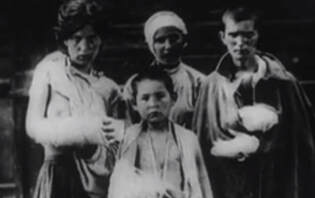
 A state of total chaos reigned in Ukraine a century ago. The Canadian-Ukrainian academic Orest Subtelny described it thus:
“In the modern history of Europe, no country experienced such complete anarchy, bitter civil strife, and total collapse of authority as did Ukraine at this time. Six different armies-– those of the Ukrainians, the Bolsheviks, the Whites, the Entente [French], the Poles and the anarchists – operated on its territory. Kiev changed hands five times in less than a year. Cities and regions were cut off from each other by the numerous fronts. Communications with the outside world broke down almost completely. The starving cities emptied as people moved into the countryside in their search for food.” The prime targets for much of the violence that engulfed the region were Jews. Historians estimate that between 35,000 and 50,000 Jews were killed in Ukraine’s pogroms in 1919-1920 – the greatest modern mass murder of Jews before the Holocaust. But unlike the Holocaust, these earlier attempts at ethnic cleansing are largely forgotten, even in their centenary year. However some fascinating footage of the pogroms has emerged on the Russian website net-film, an organisation that is digitising film archives in cooperation with Russia’s state cinema archive, Gosfilmofond. The first of the two short films covers just a small number of the hundreds of pogroms that took place in Ukraine in 1919-20. It shows still shots of shops and apartments pillaged by peasant insurgents or povstantzy in Bohuslaff (Boguslav) and by the Ukrainian army in Shitomir (Zhitomir); Jews murdered by Ataman Grigorieff in Kamenskoje (Kamianske) and by Ataman Strook in Tshernobil (Chernobyl); and rows of victims lined up in common graves. The second film shows moving images of a hospital in Ukraine treating victims of the pogroms, from the very young to the very old; several of the scenes make you wince and look away. Most interesting for me was the inclusion of victims of a pogrom in Khodorkoff (Khodorkov). Members of my family lived in the town and escaped a vicious pogrom there. Here is how I describe it in my book A Forgotten Land: “The Cossacks rounded up all the Jews and accompanied them to the sugar beet factory that stood beside the lake. Then they herded them past the plant to the water’s edge. To terrified screams and cries for mercy, the soldiers forced the Jews to continue walking into the lake until the icy water entered their bones and froze them to death or pulled them down into its depths. Bloated bodies could be seen bobbing on the lake’s surface or washed up on the shore for days. “At last a letter arrived from Kiev to tell us that our relatives had survived. Leah, Babtsy, her husband Moishe and the children had hidden in the cellar beneath Moishe’s watch shop. Babtsy had stuffed her young children’s mouths with rags to stop them from uttering a sound when they heard the Cossacks destroying the shop upstairs. Moishe winced at the noise of his precious display cabinets being beaten to splinters, panes of glass being smashed into tiny shards and his valuable clocks hitting the wooden floor above their heads. “At last the heavy thump of hob-nailed boots above them receded and they dared to breathe again. But they weren’t yet ready to risk emerging from their shelter. They listened carefully and heard the sounds of distant screams. They sensed the sweetness of the lilac that drenched the town in springtime being overpowered by the smell of fear and the stench of burning houses. They remained in the cellar all night and the next day rose to witness the devastation. Their town lay in ruins. Houses were smouldering all around them and the lakeside was littered with pale corpses. Barely stopping for a moment to grab a handful of belongings, Moishe and Babtsy fled to the railway station, a young child in each of their arms and a third running by their side, while Leah, over seventy years old now and much less vigorous than she used to be, stumbled along behind them holding onto the belt of Babtsy’s coat. They took the first train to Kiev and remained there with Moishe’s parents and sisters, who harboured them through the years that followed.” My dad and I visited Khodorkov in 2005, where we met a 95-year old woman who had lived there all her life. Her daughter, no youngster herself, shooed out the chickens and invited us into her modest home to talk with this impossibly old lady. She spoke in Ukrainian and I couldn’t understand everything, but I got the gist. “What do you remember from before the Revolution,” I asked her (in Russian). “Pogrom,” she said. “They took them to the lake.” “Who did they take?” “The Jews.” “Who took them?” “Banda.” This word banda was the same one that my grandmother had used to describe the warring parties that had passed through her village during Russia’s civil war, spoken with identical intonation. Grandma passed away back in 1988, but my father had recorded her many years earlier telling stories, in Yiddish, of her early life in Russia. It sent shivers down my spine hearing this old lady talking of the same events that Grandma had described, and even using the same word, despite the fact that she spoke a completely different language. You can view the films here: https://www.net-film.ru/en/film-68426/?fbclid=IwAR2T3VdVI42vm2sY1gHUu-UWgEbb3Ba94jMRkCGgh3bDex924otQMP_lOg0
0 Comments
|
Keeping stories aliveThis blog aims to discuss historical events relating to the Jewish communities of Ukraine, and of Eastern Europe more widely. As a storyteller, I hope to keep alive stories of the past and remember those who told or experienced them. Like so many others, I am deeply troubled by the war in Ukraine and for the foreseeable future, most articles published here will focus on the war, with an emphasis on parallels with other tumultuous periods in Ukraine's tragic history. Archives
March 2024
Categories
All
|
 RSS Feed
